
Land Acquisition in Tanzania by Non-Citizens: Transfer of Titled Property and Investment Land

Acquiring land in Tanzania for investment as a non-citizen is possible, but the process is governed by a specific legal and administrative framework. Unlike a Tanzanian citizen, a foreign investor does not ordinarily acquire land through the same form of direct ownership. Instead, land for investment by a non-citizen is generally held through a Derivative Right established under Tanzania's investment and land laws.
This distinction is important for anyone intending to purchase a house, commercial property, industrial property, agricultural land, hotel, warehouse or other real estate in Tanzania.
The process also differs depending on whether the investor intends to acquire an existing surveyed and titled property from an existing owner or seeks newly allocated General Land for a proposed investment project.
As of 2026, investors should note that the T anzania Investment and Special Economic Zones Authority (TISEZA) has replaced the former Tanzania Investment Centre (TIC) following the institutional changes introduced under the Investment and Special Economic Zones Act, 2025. TISEZA is therefore the relevant investment authority for current investment-related land procedures.
Understanding Land Rights for Foreign Investors in Tanzania
Tanzania's land system is based on the principle that all land is public land vested in the President as trustee for the citizens. The legal framework provides different rights and procedures for the use and development of land.
For foreign investors, land may be accessed for an approved investment through a Derivative Right. TISEZA's official guidance confirms that a non-citizen may acquire land for investment purposes through the investment framework rather than obtaining an ordinary Certificate of Right of Occupancy in the same manner as a Tanzanian citizen.
A Derivative Right provides the investor with a legally recognized interest in land for the approved investment. The structure is therefore different from a conventional local land transaction in which a Certificate of Right of Occupancy is transferred directly from one Tanzanian owner to another.
This distinction should be understood before signing a sale agreement or paying a substantial deposit for property.
Acquisition of Existing Surveyed and Titled Property
One of the most common situations involving foreign investors occurs when a non-citizen wants to purchase an existing property that already has a Certificate of Right of Occupancy.
For example, a Tanzanian individual or company may own a surveyed commercial property in Dar es Salaam and intend to sell it to a foreign investor for the development of a hotel, office building, warehouse or other investment project.
The transaction cannot simply be completed by signing a private sale agreement and changing the name of the registered owner. The transaction must follow the applicable land and investment procedures for disposition to a non-citizen.
The first stage should always be comprehensive property due diligence.
Property Due Diligence Before Purchase
Before entering into a binding transaction, the investor should establish the legal status , physical condition and commercial characteristics of the property.
An official search should be conducted at the relevant land registry to confirm the registered owner, title information, land area, term of the right of occupancy and any registered mortgage, caveat, restriction or other encumbrance.
The physical property should also be inspected and compared with the survey information. The plot boundaries, location, size, access, existing developments and actual use should correspond with the relevant land and survey records.
A professional land surveyor may be required where boundaries or survey information need to be confirmed.
The investor should also establish whether land rent and other obligations have been paid and whether there are any disputes, pending transactions or third-party claims affecting the property.
This stage is particularly important because possession of an original title document does not, by itself, establish that the property is free from all legal or financial obligations.
Documents Required for Disposition to a Non-Citizen
The documentation required depends on the circumstances of the property and the parties, but a typical transaction file may include the original Certificate of Right of Occupancy. Where the certificate has not yet been issued, the relevant Letter of Offer and evidence of payment may be required.
The parties should provide appropriate identification and evidence of citizenship or nationality. For a foreign investor, a valid passport and the relevant investment and corporate documents should be prepared.
A properly prepared sale agreement is also required. It should clearly identify the property, purchase price, payment arrangements, completion conditions, responsibilities of the parties, applicable taxes and government charges, and the obligations necessary to complete the foreign investment land process.
Where required, at least three original executed copies of the sale agreement may be prepared for submission and registration purposes.
A professional valuation report should also form part of the transaction documentation. The valuation should identify the property accurately, consider relevant market evidence and establish the appropriate market value for the purpose for which the valuation is being undertaken.
Evidence of payment of current land rent should also be available.
The applicable land forms form an important part of the disposition process. These may include Land Form No. 29, relating to notification of disposition, Land Form No. 30, relating to application for approval of disposition, and Land Form No. 35, relating to the transfer instrument.
Where applicable, spousal consent should also be obtained, particularly where the property may constitute matrimonial property.
An updated official search should be conducted as part of the legal due diligence and, where necessary, again before completion to ensure that no new encumbrance or transaction has been registered during the process.
Valuation of Property for the Transaction
Valuation is an important component of a formal property transaction involving a non-citizen.
A valuation report provides an independent assessment of the market value of the property and may be used for government assessment, taxation, transaction approval and other purposes.
The valuation should be undertaken by an appropriately qualified and registered valuation professional and should clearly state the interest being valued, the effective valuation date, property particulars, land and building characteristics, valuation methodology and market evidence.
It is important to distinguish between the value of vacant land, land and buildings, an existing right of occupancy, leasehold interests and other property interests because the nature of the interest being transferred can affect the valuation and transaction structure.
Notification and Approval of Disposition
After the sale agreement and supporting documentation have been prepared, the disposition must proceed through the applicable government approval process.
The notification of disposition and application for approval are important stages because the transfer of a registered right of occupancy is subject to statutory requirements.
The application may include Land Forms No. 29 and 30, the relevant transfer instrument, sale agreement, valuation report, original title, evidence of land-rent payment, identification documents, official search and other supporting documents required by the land authorities.
Government fees and other charges applicable to the transaction should be confirmed using the current assessment or payment instructions issued by the relevant authority. Fees can change, and amounts quoted in older property documents should not automatically be treated as the current applicable charges.
From the Existing Title to a Derivative Right
The most important difference between a normal local transfer and a foreign investment transaction is what happens to the existing land right.
Where a foreign investor acquires an existing property for an approved investment, the process may involve the existing title being surrendered to the Commissioner for Lands and the land interest being dealt with through the investment authority before the investor's Derivative Right is established.
The process should therefore not be understood simply as:
Tanzanian Owner → Foreign Buyer → Existing Certificate of Right of Occupancy
Instead, the transaction follows the applicable investment-land framework, through which the underlying land interest is processed and the foreign investor ultimately receives the appropriate Derivative Right .
This is why foreign investors should obtain professional advice before signing an unconditional sale agreement. The legal structure of the transaction should be considered from the beginning rather than after the purchase price has already been paid.
First-Time Allocation of General Land for Investment
A different process applies where an investor is seeking land that has not previously been allocated and is intended for a new investment project.
The process begins with identification of suitable land and verification of its legal and administrative status.
The fact that land appears vacant does not necessarily mean that it is legally available for allocation. The relevant authorities must establish whether the land has previously been allocated, occupied, surveyed, reserved or is subject to existing claims or restrictions.
The proposed land should therefore be investigated through the appropriate land offices, survey records and other official sources.
Identification and Verification of General Land
The proposed investment land should be assessed in relation to its location, size, accessibility, existing land use, planning status, survey status and suitability for the proposed investment.
The availability of roads, electricity, water, telecommunications and other infrastructure may also have a significant effect on the feasibility and value of the investment.
Where the land is intended for a major investment, a professional site assessment should be conducted before the investor commits significant capital.
Physical inspection and professional survey information are particularly important because online maps and satellite imagery cannot, on their own, establish legal ownership or availability of land.
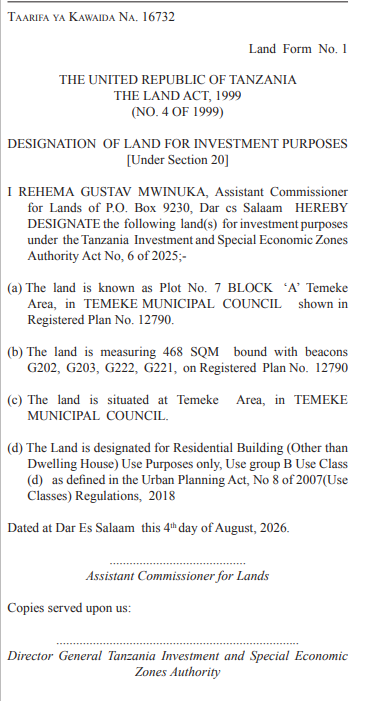
Gazettement and Land Form No. 1
Where the applicable investment land allocation process requires designation and gazettement, Land Form No. 1 is used as part of the formal procedure.
The relevant land authorities undertake the necessary assessment and prepare the documentation for gazettement in accordance with the applicable regulations and administrative requirements.
Gazettement is an important stage because it formally brings the identified land into the prescribed government process for investment allocation.
The investor should understand that identifying a particular parcel does not automatically create a legal entitlement to that land. The allocation remains subject to the relevant government approvals and applicable land and investment requirements.
Allocation and Registration of Investment Land
Following the applicable designation and gazettement process, the proposed allocation is considered through the relevant government procedures.
Where allocation is approved, the necessary land documentation is prepared and processed through the land registration system.
Under the current investment-land framework, the underlying Certificate of Right of Occupancy is processed through the prescribed investment structure, after which the investment authority facilitates the establishment and registration of the investor's Derivative Right.
The investor's legal interest therefore arises through the approved investment structure rather than through an ordinary direct transfer of land ownership to a non-citizen.
TISEZA and Investment Registration
The role previously performed by the Tanzania Investment Centre should now be understood within the current Tanzania Investment and Special Economic Zones Authority (TISEZA) framework.
TISEZA is responsible for investment promotion, registration and facilitation and plays an important role in investment-related land matters.
Depending on the nature and value of the proposed project, an investor may need to register the investment project and obtain the relevant investment documentation.
Where applicable, the investor may also seek a Certificate of Incentives. This should be distinguished from the land right itself. An investment certificate or Certificate of Incentives does not, by itself, constitute the investor's land title or Derivative Right.
The land right and investment approval are related components of the investment structure but serve different legal purposes.
Why Professional Valuation, Survey and Legal Due Diligence Matter
A foreign investor acquiring land in Tanzania may need to coordinate several professional services.
A registered valuation professional can establish the market value and prepare the required valuation documentation.
A licensed land surveyor can verify boundaries, survey information and the physical position of the property.
A qualified legal professional can review the title, conduct legal due diligence, prepare or review the sale agreement and advise on the transfer and registration process.
A land administration professional can assist with land-office procedures, land-rent matters, title documentation and other administrative requirements.
Investment professionals can assist with the investment registration and coordination of the investment-land process.
The involvement of the appropriate professionals at an early stage can significantly reduce the risk of delays, incomplete documentation and disputes.
Common Issues That Delay Foreign Investment Land Transactions
Many problems in land transactions arise because due diligence is performed too late.
A buyer may discover that the seller's title has an outstanding mortgage, that land rent has not been paid, that the property boundaries do not correspond with the survey, or that the intended development is inconsistent with the approved land use.
Other transactions may be delayed because the parties have prepared a sale agreement without considering the additional requirements applicable to a non-citizen.
Foreign investors should also be cautious about relying on older information referring exclusively to TIC. Since the institutional framework changed with the establishment of TISEZA, current procedures and requirements should be confirmed before submitting an application.
A Professional Approach to Foreign Investment Property Acquisition
A properly structured transaction should begin with due diligence rather than payment.
The process can generally be viewed as:
Property Identification → Official Search and Due Diligence → Survey Verification → Valuation → Investment Assessment → Sale Agreement or Land Application → Government Approval → Applicable Payments and Taxes → Land Registration Process → Derivative Right → Final Documentation
The exact sequence depends on whether the investor is acquiring an existing property or applying for newly allocated investment land.
The nature of the investment, type and category of land, ownership structure, location, value of the project and applicable government requirements must all be considered.
Conclusion
Foreign investment in Tanzanian land is legally possible, but it requires a properly structured transaction that complies with the country's land and investment framework.
For an existing surveyed and titled property, the process involves much more than signing a sale agreement. The investor should undertake official title verification, physical and survey due diligence, valuation, preparation of the relevant land forms, notification and approval of the disposition, payment of applicable taxes and government charges, and completion of the prescribed registration and investment-right process.
For newly identified General Land, the process may involve land identification, verification of availability, designation and gazettement, allocation through the relevant government procedures, registration of the underlying land interest and creation of the investor's Derivative Right.
The central principle is simple: a foreign investor should establish the legal and investment structure of the land transaction before committing substantial funds.
Professional valuation, surveying, legal due diligence and land administration support can help investors understand the property, identify potential risks and navigate the applicable government procedures.
Danvast Land and Property
Danvast Land and Property provides professional land and real estate services in Tanzania, including property and asset valuation, land surveying, title deed processing, land titling, land administration, property due diligence, property transactions, real estate agency and investment-related property advisory.
For foreign investors, Danvast Land and Property can coordinate professional services relating to property valuation, land verification, survey coordination, title documentation, land administration and real estate transactions, helping investors make informed decisions before committing their capital.
Secure your plot. Secure your investment. Secure your future.
Important Legal Notice
This article provides general information about land acquisition and investment procedures in Tanzania and should not be treated as transaction-specific legal advice. Land laws, regulations, government procedures, forms, fees, taxes and administrative requirements may change. Investors should confirm the current requirements with the relevant land authorities, TISEZA, TRA and qualified legal and professional advisers before completing a transaction.
News insight
 Feb 14, 2026
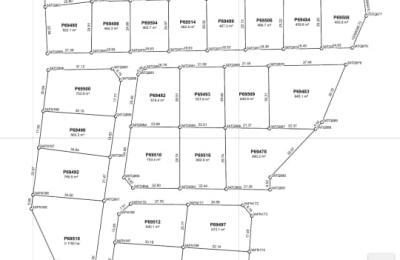
 How to Verify Land Title in Tanzania: Legal Procedure, Institutional Review, and Modern Verification Systems
Land verification in Tanzania is a legal process grounded in statutory law and administered through...
 Dec 23, 2025
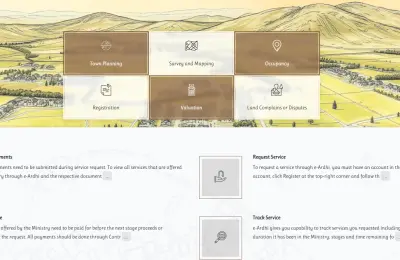
 Tanzania e-Ardhi System 2025: An In-Depth Guide to Digital Land Services, NIDA Registration, and Online Applications
A detailed guide to Tanzania’s e-Ardhi system explaining NIDA registration, online land title applic...
 Dec 20, 2025
 Houses, Apartments, Plots & Viwanja for Sale in Dar es Salaam
Dar es Salaam is one of the fastest-growing cities in East Africa, making real estate investment in...